
EVENT FULLY BOOKED
The Scottish poet, artist and gardener Ian Hamilton Finlay (1925-2006) lived in a number of rural locations around Scotland. For a few months in 1959 he lived and worked in the Sourin district of Rousay, and although he only returned to Orkney once more, the island and its maritime setting strongly influenced the course of his career. And further, through a kind of mythic displacement, it grew into a place of personal and creative origin.
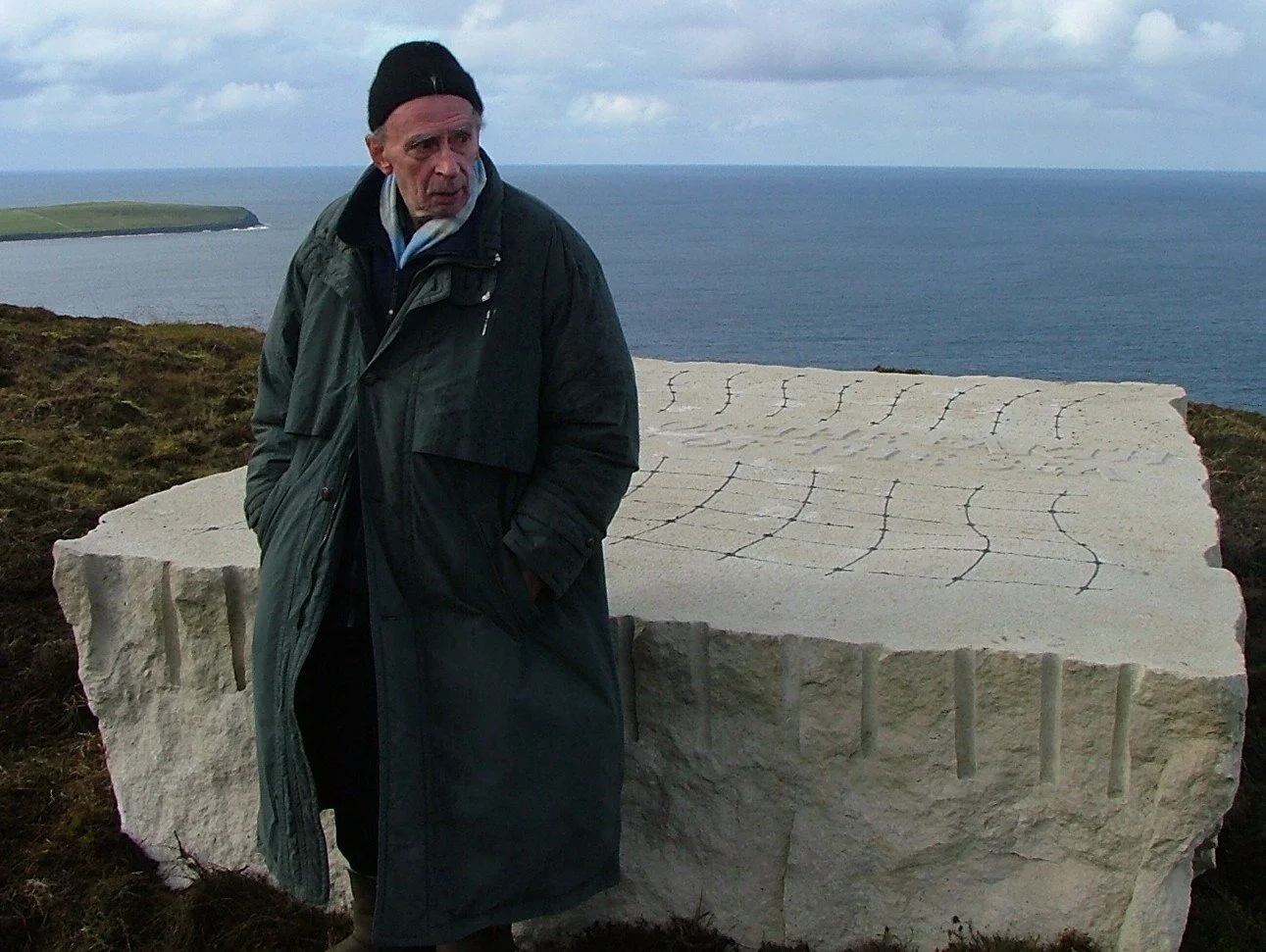
His monumental sculpture Gods of the Earth/ Gods of the Sea, created in collaboration with stone-carver Nicholas Sloan, was installed, under Finlay’s guidance, at a location near Blossom Quarry in Rousay in 2005, shortly before the artist’s death.
Yet despite its importance, and consistent with that mythification, little has been known in detail about that visit, even for many years when it took place, and for how long. As explained below, in the wider context of Finlay’s early life and his later creative achievements at Stonypath, Little Sparta, this has been the focus of research by Dr Alistair Peebles, an Orkney resident and the poet’s early biographer.
Join Alistair on this first-ever walking tour of the main sites of interest in relation to Finlay’s 1959 visit to Rousay, and in relation to the poetry that he wrote there and published the following year in The Dancers Inherit the Party, which first made his name internationally.
Come prepared for the weather. The ground in places will be uneven. A minibus will be available, and lunch is included in the ticket price.
£40 (including ferry travel)
£30 (without ferry travel)
Spaces are limited. Booking essential. To book phone the Pier Arts Centre on 01856 850209 or email info@pierartscentre.com
To secure a place, please book before Saturday 8 August.
10:40 Tingwall to Rousay ferry
11:15 Meet at the Pier Restaurant for orientation and refreshments.
13:00 Lunch at the Pier Restaurant
15:20 Rousay to Tingwall ferry
For more information, read part 1 of Such an Air, to be published in 5 parts over the coming weeks. This comprises Alistair’s narrative account of Finlay’s coming to Rousay in 1959, and impressionistically of his first weeks there.
More about the event:
“The Orkneys. Or, as Finlay puts it, Arcady.” (Yves Abrioux, Ian Hamilton Finlay: A Visual Primer (Edinburgh: Reaktion Books, 1992) pp. 1 & 309.)
“Many Orcadians know Ian H. Finlay, the writer who has stayed mainly in Rousay for different periods, and is an Orkney writer by adoption and inspiration.” Thus, in The Orcadian 15th March 1962, under the headline “New Poems by a Rousay Writer”, George Mackay Brown began his review of Ian Hamilton Finlay’s hilarious Glasgow Beasts, an a Burd Haw, an Inseks, an Aw, a Fush, his “wee buik for big weans”.
What was that connection? Is there still a connection? Finlay spent only a few months in Rousay in the 1950s, but the work that he produced there on his second visit in 1959 led to seminally important developments in his career, and it would remain an important place for him thereafter. It was a place indeed of mythic origin, and Finlay was a mythmaker. Though he was actually born (“inappropriately”) in the Bahamas, he once said that in order to understand his work it was “better to believe” that he had been born in Orkney. Of the poems in his 1960 volume The Dancers Inherit the Party, half numerically concerned the islands. This was his only collection of lyric poetry—he soon rose to prominence in the international movement of concrete poetry—and it first made his name internationally.
Finlay went on to achieve fame not only as a poet, but as an artist and landscape designer, based at Stonypath in South Lanarkshire, the upland farmstead where he and his family made their home in 1966. An agoraphobe, he virtually never left the property and its close surroundings until very late in his life. Best known since c.1980 as Little Sparta, largely created in collaboration with his partner Sue Finlay (now Swan), and often the centre of protracted public controversy—battles and “wars”, including with the then Strathclyde Region—his garden there, a neoclassical Arcadia, is now widely acclaimed as Scotland’s most important contemporary work of art.
Finlay’s centenary last year was marked by numerous exhibitions internationally, including at the Pier Arts Centre. From 1970, a total of around 80 landscape installations were commissioned from Finlay for sites throughout Europe and the US, as well as in the UK, including latterly by the Pier Arts Centre. This was a commission that Finlay was very keen to see realised, and the installation of Gods of the Earth/ Gods of the Sea, in 2005, in Rousay, was the occasion of his third and final visit to the island. There, some five or so decades previously (at that stage the history was very hazy), he had been “born as a poet”.
Finlay’s work, though in a very disciplined way, crossed conventional boundaries. While in the field of visual art, the significance of his connection with Orkney, obscure as it was, was not lost on the Pier Arts Centre, this was not the case in other contexts locally. Nor as regards his life was either his historic, or the nature and significance of his mythic connection with the islands understood with any clarity.
Over the past decade and a half, Alistair Peebles has made a point of researching these topics in the context especially of Finlay’s pre-Stonypath biography, itself in large part unknown. Last year with film-maker Michael Lloyd he completed a documentary film about the year the Finlays spent near Ardgay, 1965-66, The Boat in the Writing Room, which premiered at the Pier Arts Centre in October (see alistairpeebles.com/seekers-of-the-lost-ark-arc/). At present, his Rousay Mending, a homage to Finlay, with Rousay Mending: a Footnote, is nearing publication under his imprint, Brae Editions, and it should be out in early August. His account of Gods of the Earth/ Gods of the Sea, to be published in collaboration with the Pier Arts Centre, is expected later in the year. He will soon begin work on an early biography.
This will be the first such tour of the main sites of interest in relation to Finlay’s 1959 visit to Rousay. Ideally participants should have some knowledge of Finlay’s Orkney poems in The Dancers Inherit the Party, but by courtesy of his Estate, excerpts will be provided, and a slide show will help provide context. The most comprehensive recent volume of his writings was edited with an introduction by his son, the poet Alec Finlay, whose Ian Hamilton Finlay: Selections, was published in 2012 by the University of California Press. This is still available in bookshops and elsewhere.